
When We Choose Violence
Hey. Don't worry. It's just a story about an angry kid, a swimming pool, and a dog.

We grew up solidly middle-class. My Little Rock readers will know what I mean when I say we were Hillcrest kids, not the Heights. For St. Petersburg readers, think maybe Tyrone instead of Old Northeast or Jungle Prada.
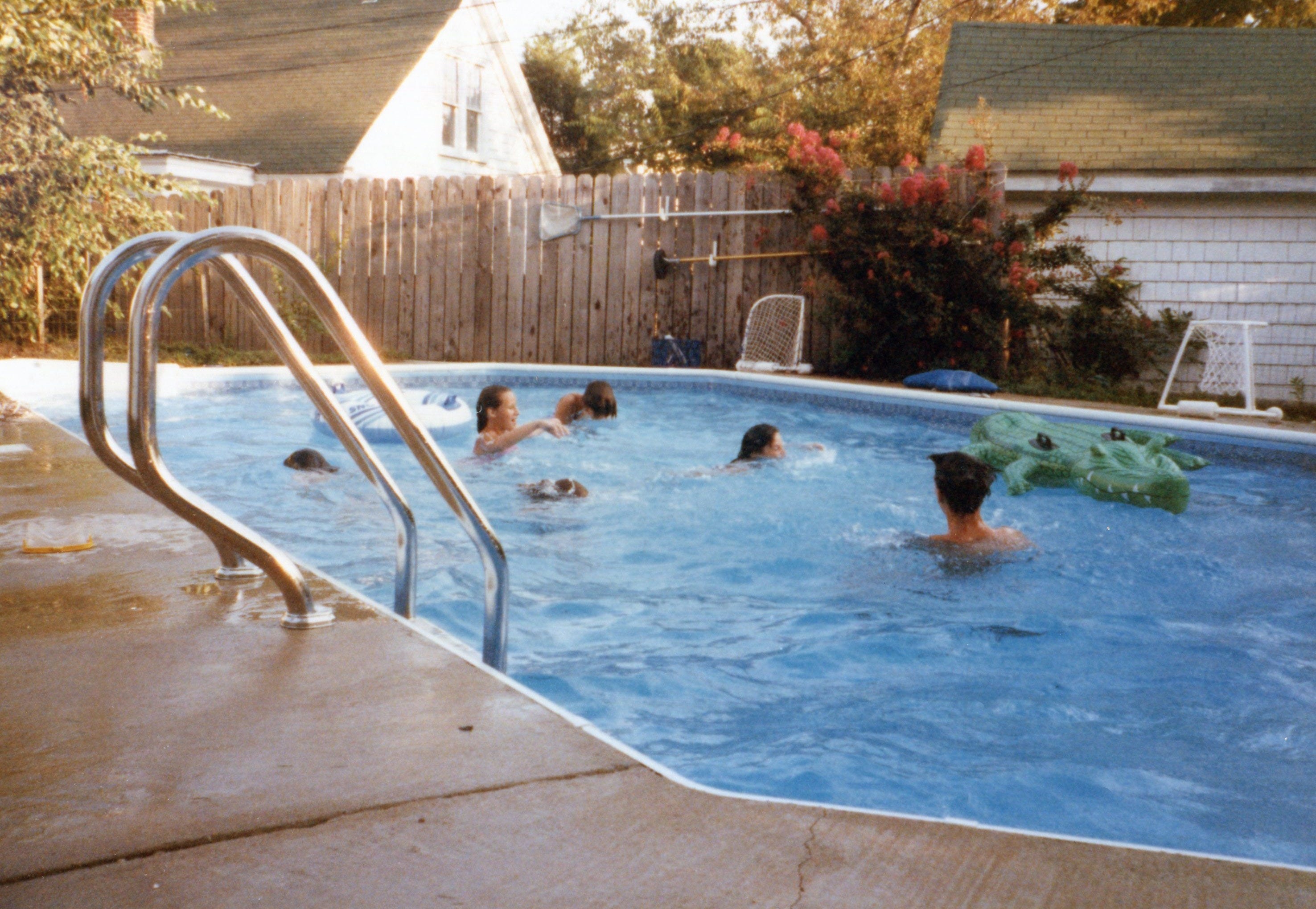
Still, we had managed our money effectively enough. So, some time in the mid-80s, we decided to put in a swimming pool at our house.1
I was around fourteen, and I enjoyed swimming, so this was great news. In fact, I was probably in the best shape of my life the year I was fifteen or so, running distance track for high school and swimming in our pool.
Our house was already something of a neighborhood touch-point. A gathering place. The house where I did most of my growing up had a nice, open concrete front porch. I remember summer nights with neighbors joining my parents there. Gently swinging in the glider. Relaxing in the rocking chairs. Drinking Miller High Life, or gin and tonic, and talking about whatever it was grown-ups talk about. We kids mostly rode our bikes up and down, or played ball in the street.
I’m not sure having a pool makes a ton of sense in a place like Arkansas. Sure, it was great around May, into June. July and August for sure. Maybe into September, but the cover was going on before Halloween. Seven, eight months of no use out of the year? I don’t know.
I had to be sixteen. My junior year of high school. I know this because crucial to the story was me driving home from school in my own car. Mom was a librarian, Dad was out working. Adam and Susannah, still in school. I enjoyed those days, coming home and having the house to myself. Not because I was into mischief or something tawdry, but because I could read my comic books and cheap novels uninterrupted.
I can’t tell this story without telling the story of Bear.
Bear was our Newfoundland dog. Covered in thick, black fur, she came to us as a puppy, a Christmas present for the family one year. She had the sweetest disposition of any dog I’ve ever known. But she wasn’t just obedient, she was, in the way of a dog, nurturing. Bear had a genuine spirit, and if ever there were a member of our family who was not human, it was Bear.
Bear stayed on our back porch while we were all gone, with a doggie door to head outside if she needed to. Of course, she knew no enemies, wanted to make friends with everyone. This sweet, loving dog only wanted you to rub her ears and say nice things while she slobbered all over you.
So when I got home that day after school, what I saw in the back yard from our kitchen window took me a long moment to process.
There were four of them. Boys. Maybe they were twelve or so, I don’t know. Younger than me, closer to my brother’s age for sure. In my memory, they are all fat. Fat in that way American kids can get when they’re lazy and stupid and don’t care about anything.
Two were swimming in the pool. Which, when I saw the third standing at the other edge pissing in it, made it all the more gross.
The fourth was kicking Bear.
Hard as he could. Shirtless, in his goddam swim trunks (they’d planned sneaking into our backyard and swimming in the pool while we were gone). Barefoot — but a raring back, full-on, aiming-for-the-uprights kick. Bear’s wild yelp of pain rattled me out of the fog of shock.
I ran out back. When they heard the back door slam, they took off running. The two in the pool were out and climbed over our tall fence in a split second. The third had… finished his business and gone over as well.
But I cut off the one who had kicked Bear. He made a break for our gate knowing he couldn’t flop his fat ass over the fence before I grabbed him. Our gate, like every gate to a wooden fence I’ve ever encountered in my entire life, would stick. You had to jiggle the handle just so, pull with just the right force.
I caught the fat little turd at that gate. He was hyperventilating, in a panic.
“I’m… I’m… I’m…,” he was trying to say I’m sorry, but he couldn’t get it out. His pupils were blown and he looked like he was trying to melt into the ground.
What I tell people — what I have always told people — happened next is that I hit him.
I say, “I hit him as hard as I could,” and then I say he cried a lot. I make myself look magnanimous and merciful. I say I kindly let him out, and I finish the story, which I will do soon.
But that is not entirely accurate. It is a whitewashing, a cleansing of what I actually did that day. A spin job, at least a little bit of one.
I hit him. I hit him in that fat, flabby stomach as hard as I could. Hard, with my right fist balled tight. I hit him so hard, I felt the air go out of him. It was a solid punch from a kid that didn’t really know how to throw a good punch, which was undoubtedly to the fat kid’s benefit. Still, it was hard enough, I swear I could just about feel his spine at the edge of my knuckles. He threw up a little on my shoes and on the ground.
It was at this point something happened to me. Maybe it was the power I had over the helpless kid. Maybe the realization that I could have whaled on that kid all day. I wasn’t tired. I felt no pain of my own. To the contrary, it felt good. Really, really good.
Maybe it was just the satisfaction of avenging my aggrieved dog. I don’t know. But I felt myself smile a bright, wide smile.
That’s not the part that scared me, though.
I squared my shoulders and put my hand under his chin. I pulled his head up, straightening him out. I pinched his cheeks, puffing out his lips. And I leaned in, as if we were going to kiss.
When they learn I am from Arkansas, people will comment more often than you might think about my lack of accent. And it is true, the accent was trained out of me in college when I was going to be a radio disc jockey. But when the circumstances are right, it can come back. For example, when I am knee-crawling drunk. Or when I am enraged.
I like to think my accent is a little bit of a gruff version of Tommy Lee Jones. But I suspect it’s a lot more Sheriff Roscoe P. Coltrane.
I leaned in to the kid and said in a voice that should have been trembling in fear and adrenaline but was instead smooth as whiskey, “Come back here and I’ll kill you.”
The kid let out a kind of half-whine, half-yelp through his wheezing, sloppy crying, blowing snot bubbles, nodded as best he could with his head in my hand. He was beyond talking.
I was taken aback enough by my own words — words I knew I meant — that I finally, abruptly just pushed him aside, jiggled open the gate, and let him run out. I had threatened this kid’s life. No idea who he was. It didn’t matter. He’d harmed something precious to me.
But was this the way? Was hitting him the thing to do? Was threatening him, a threat he wouldn’t soon forget, one he may remember even today, the right answer? We always condemn violence, in all its forms. So is a violent reaction ever the right answer?
These questions all felt like too much. It felt overwhelming. And I was angry. Why was I the one who felt bad? After all, it wasn’t me who pissed in the pool and kicked the dog.
It was the first time in my life I wished my parents got home faster than they did.
In the end, my parents put the lie to my threat. In addition to being crappy little animal-abusing brutes, they were stupid as well. Every one of them left their wallets by the pool. Wouldn’t want to get your money wet, I guess.
My mother and father called each of their parents. I had told my parents I chased them off. I did not tell them about my own violence until several years later.
My parents made their parents bring them to our house and apologize to our family for the invasion of privacy. Only then would they get their wallets back.
To my recollection, they all did.2 Even the ones who were very well politically and socially connected.3
One of the kids who jumped the fence arrived with his father. And, after the kid sheepishly apologized to us, we watched as his father whipped the shit out of him, right there on our front porch.
A day for violence, I suppose.
You know, I have heard some pretty aggressive, negative comments about myself from my time in politics and government. Happens when you’ve been involved in public life for coming up on 35 years. I heard it a lot in school, too, after this event. I have heard it from former romantic partners. I’ve heard it from friends.
Too cautious. Too careful.
My track coach telling me I didn’t have any drive, didn’t have that“do or die” ability (but if I wanted to take the yearbook photo with the team, I could). The rugby guys in college telling me no thanks, I lacked “killer instinct.”
I once had an active duty military officer and colleague in Washington, D.C. tell me that the only way to truly be a patriot was to spill blood on a battlefield.4 What he meant was that I was a desk jockey and my service as an employee of the United State Federal Government didn’t really measure up.
I was once told by a very high level aide to an extremely high level political figure that if I ever uttered the name of that political figure in public again, he would crush me under his boot heel, and, quote, “it would be easy.” This was a former colleague, by the way.
I’ve been described by detractors as a “afraid of his own shadow.” I’ve heard “wimpy” (which always makes me think of the Popeye character, J. Wellington Wimpy, and his famous catchphrase, “I’ll gladly pay you Tuesday for a hamburger today,” and then I want a burger. And a good burger will fix just about anything.) “Mouse of a man” is one that sticks with me. You don’t have to scroll through social media to find far, far worse.
For the record, I see the pattern. But I don’t think any of these are fair. Nor are they accurate. I wouldn’t have had a successful 35 years in politics and government if they were. And anyway, I’ve built up something of an immunity.
I believe it is important to think twice before escalating a confrontation. It doesn’t mean I won’t do it.
It might seem satisfying to hear about a teenage me pummeling some kid. Especially if you’re an animal lover. But what I learned that day is that when you let rage get the better of you, when you let the bullies — the dog-kickers — drive you to violence yourself, well, you’ve lost, too. In more cases than we care to admit, the better answer is to stand back, take a breath, and let the instigator sit with their own misery.
Some nights I dream about that day. Some nights I imagine hitting that kid and never stopping, not until he’s nothing but a bloody spot the ground. Some nights I imagine I am that father, whipping all of those kids with a belt, not just his kid. Some nights I dream that I turn into a dog and Bear and I hunt them down and eat them against the backdrop of a full moon.
Violence, including reciprocated violence — verbal, emotional, or physical — is a burden. And it is one you have to carry forever, perpetrator or victim.
I don’t know what got me thinking about that story, about unnecessary attacks that amount to their own kind of violence. I don’t know what got me thinking about violence — verbal, online, whatever, the broadest definition of it. Violence. I don’t know what got me thinking about what is really just a broad, fancy word for a way in which we treat one another poorly, including how we react to how we are treated. I don’t know what got me thinking about the deep desire to react in an emotional way that itself is a sort of violence, one perpetrated onto another person, but also, in the end, on one’s self. There is a deep desire in all of us, a deep temptation to reciprocate, to say something sharp back, to do something sharp back. To hit back.
Who knows what I’m thinking about.
Hell, maybe I’m just nostalgic for a time when violence and the spectacle of it in all its forms were not fully the coin of the realm.
It was a long forty-something years or so, carrying that burden. But the burdens we carry are not what define us. It is how we cope with them that are the measure of our character.
Over the years, I have learned to justify what happened back then by telling myself I was defending my dog, my property, my home. There is truth in that. But it doesn’t diminish the consequences.
I’m also not naive. The world is a violent place. It is a hard truth that attacks should sometimes be met with like violence, or at least some kind of response. It is a price we pay as a violent species. It is innately human. It is a burden we all will carry, one way or the other, throughout our lives.
The question we have to get better at answering is, where does it end?
I think this is why I tend to write stories that include considerable violence. Not because the violence is in and of itself entertaining (though I try to make it so for the sake of the story). But to try to get to that answer, that solution. How can we get through it to find something peaceful?
Violence — whatever form it takes — is a cycle. And not just for those on whom it is perpetrated. It lives on with those who engage in it as well. It even lives on for those of us who have to pay witness to it. And, as necessary as it may be, it is almost never for the better.
Anyway, here’s to more peaceful times. For each and every one of us. Thanks for reading.
“We” had nothing to do with it, of course. I was a teenager, as was my brother, barely. This was all thanks to my parents. My father worked hard, as did my mother, and they decided put in a pool. Their three children were simply the fortunate beneficiaries.
I’ll ask my father, but I think that’s right.
I won’t name any names, of course, but I’ll leave it to you to decide what the implications of being well-connected politically and socially in Arkansas in the mid- to late-1980s might mean.
In total fairness, this was a man who had absolutely spilled blood on a literal battlefield, had done so more than once, and in fact was so proficient in doing so, he later taught warfare as a college course. Despite my lack of military service, he came to like me and, I think, even respect me. He also took me to the famed Daiquiri Lounge of the Army Navy Club of Washington, D.C., where the daiquiri was first introduced to America. We drank daiquiris and had a very good time. Our stories are journeys, people.